
In this post, I’d like to share some key takeaways from a rather “heated” conversation I had with a mentor and friend in the field of Occupational Safety and Health (OSH).
It wasn’t exactly a formal interview, but our casual discussion turned out to be surprisingly deep and critical.
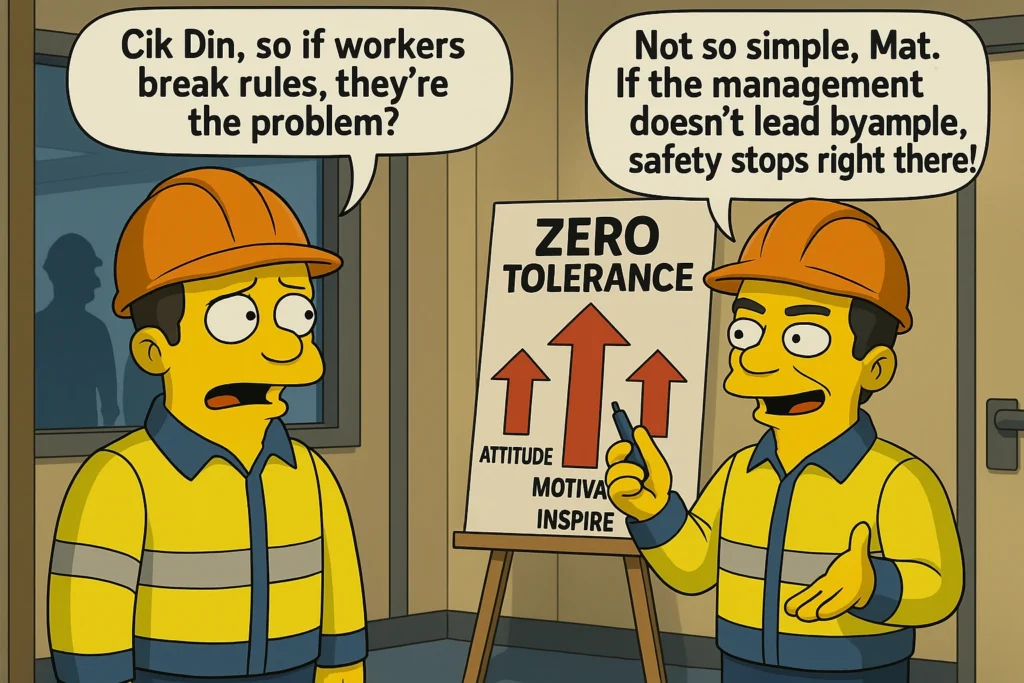
When Workers Break the Rules
Me: One of the biggest issues faced by organisations is employees who do not follow safety rules or standard operating procedures (SOPs). What should management do with such workers?
The Expert: Many organisations have long relied on disciplinary actions or “catch-and-punish” programmes. While this sometimes works, it often harms workplace culture. Punishment alone does not fix behaviour. What matters more is changing the attitude behind it.
Is It All About Behaviour?
Me: So, are you saying this is about Behaviour-Based Safety (BBS)? Recently, many have started exploring BBS, while others criticise it for “blaming the worker.”
The Expert: The truth is, BBS focuses on observing and understanding behaviour, both past and present. I personally emphasise looking at a worker’s character, as it can often predict future behaviour. The goal is to help people change through the right tools, coaching, and awareness of why safe practices matter.
Changing someone’s character doesn’t automatically make them safe, but once they understand themselves and their habits, they can change how they act at work.
Me: What do you mean by habits and character?
The Expert: Everyone has different personalities. It’s how we live and how we behave when no one is watching. For example, some people, including myself, tend to practice safety and health at work but not so much at home. Ask my wife, I’m guilty of that!
At home, we feel relaxed and “off-duty.” Our minds are trained to think safety is part of the job, not part of life.
Me: Hasn’t personality testing already been used during job interviews and employment?
The Expert: Yes, personality tests have been used for years, but mostly for senior executives, not general workers. We often assume that once workers attend training or induction, they’ll automatically follow procedures.
Me: But doesn’t using data like this end up blaming a certain group for example, only the workers?
That’s not true. We forget that workers are not robots, they have personal lives and emotional struggles. Studies show that 6 out of 10 workplace incidents and fatalities are related to a worker’s attitude or behaviour.
Some argue that such data unfairly blames workers. But that’s not the point. Data is a mirror, it reflects management’s own analysis. It should be used for learning and improvement, not finger-pointing.
Management and supervisors share the same responsibility. Every worker’s mistake reflects a gap in supervision or management commitment.
Me: So who exactly needs to change their attitude first, and how?
Change must start with management. They need to understand that policies and systems only work when they reach every level, supervisors and workers alike. The key is leadership through awareness and example, not through orders or fear.
For example, when driving and receiving a message, the right behaviour is to resist the urge to check it until you stop safely. These small, practical habits are what real behavioural change looks like.
Me: Often time supervisors seem to struggle so much, but why?
Supervisors often say they have no time to read documents or safety manuals. And they’re right to some extent. They work on-site, in tough weather, with long hours and many distractions.
That’s why management must make things practical. Don’t overwhelm supervisors with endless documentation. Give them what they need, logs, checklists, work instructions and make sure these include safety, health, and environmental references where necessary.
This way, safety becomes part of the job, not an extra task.
Think of it like a ship. The Captain represents the supervisor, while the General or Commander represents management. When the ship sails, the Captain leads the crew, even if the General is onboard. The General should respect the Captain’s authority and not interfere unless asked.
Similarly, management should understand the supervisor’s position and empower them to drive safety culture at the ground level. Supervisors are the bridge between top management and workers. They are the real catalysts for change.
Lesson Learned
Workers are human beings with emotions, not robots or slaves. Yet many employers still say things like, “If you don’t want to work, there are many others waiting outside.”
With foreign labour from Nepal, Bangladesh, Indonesia, Pakistan, Myanmar, and Cambodia available at lower wages, it’s easy for some companies to replace people without improving safety conditions.
The message is simple: treat workers with dignity, invest in their safety, and culture will follow. Because when management changes first, everyone else will follow naturally.