
Many times in life, we tend to overthink things until they become unnecessarily complicated. The same can happen in managing occupational safety and health (OSH).
It’s not that safety practitioners out there are not doing a good job, but sometimes we may lack critical reasoning when presenting arguments and justifications especially when dealing with management.
If what we say doesn’t make sense to management, it becomes difficult to get their full commitment to workplace safety.
Scenario 1
A restaurant management refuses to serve drinks using trays, claiming that their staff have not been trained in occupational safety and health for carrying trays. Instead, they serve food and drinks using trolleys.
Answer: Serving drinks using trays is not covered under any OSH law. However, restaurant staff can be internally trained on proper etiquette and handling techniques by the management.
Scenario 2
A school forbids students and teachers from sticking artwork or notices on the BT-brand glass windows. The reason given was that the chemicals used to make the glass could cause it to crack or shatter under high temperatures.
Answer: Glass breakage is usually caused by impact from hard objects, structural instability, fire, or natural disasters. It has nothing to do with the chemicals used in the BT-brand glass, nor with sunlight or temperature.
The role of the authorities is only to ensure that the chemical components used are not from the prohibited list. If they were, enforcement action would be taken against the manufacturer. Cross-checks show that the chemicals used actually meet the standard for strengthening the glass, not weakening it.
Scenario 3
A souvenir shop refuses to sell embroidery needles due to occupational safety and health reasons.
Answer: There is no law that prohibits any shop, including souvenir shops, from selling sewing or embroidery needles.
Scenario 4
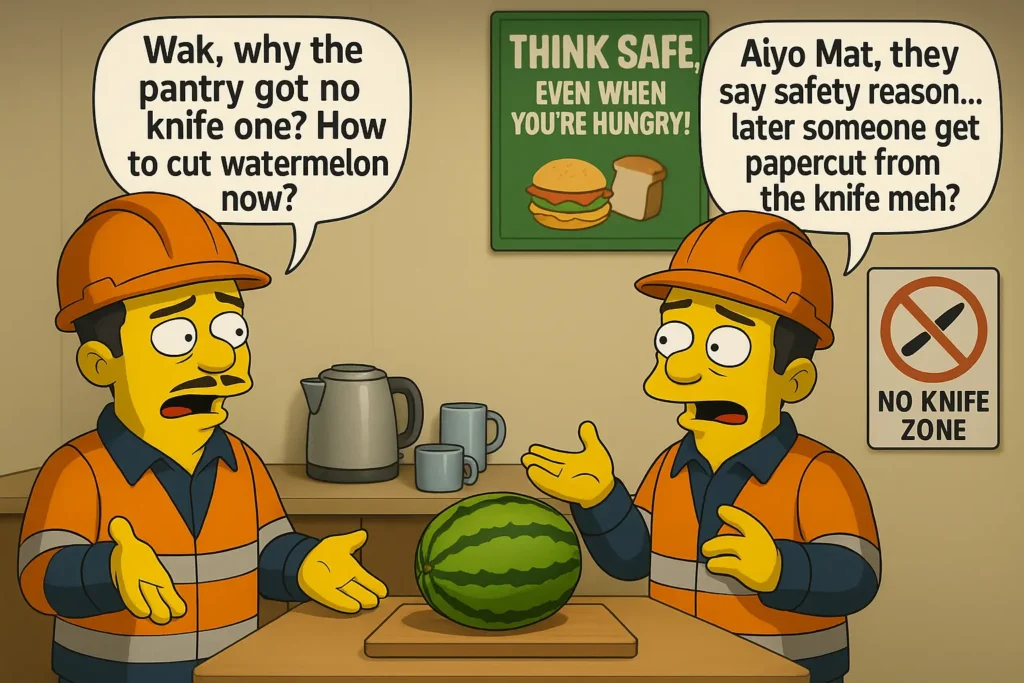
A company’s pantry or kitchen does not allow knives to be used for safety and health reasons.
Answer: No OSH law forbids the use of knives in a pantry or kitchen. Staff simply need to handle them with care. If a knife were ever used in a criminal act, that would fall under police jurisdiction, not occupational safety.
Scenario 5
A hotel guest complains that the hotel does not provide a floor mat outside the bathroom. The hotel claims that the mats are not supplied for safety reasons, fearing that guests might slip when stepping on them.
Answer: There is no OSH law prohibiting the use of floor mats. The hotel’s decision is impractical because slipping depends more on how slippery the floor is, not on the presence of a mat.
Lesson Learned
When workplace safety and health are implemented without clear understanding or proper guidance, employers may end up creating more confusion than protection.
Overdoing safety just for the sake of appearing “safe” can backfire and cause inefficiency or even ridicule. It’s like planning a wedding where everything becomes overly complicated, “too many rules, too much drama, and in the end… the wedding never happens“.