
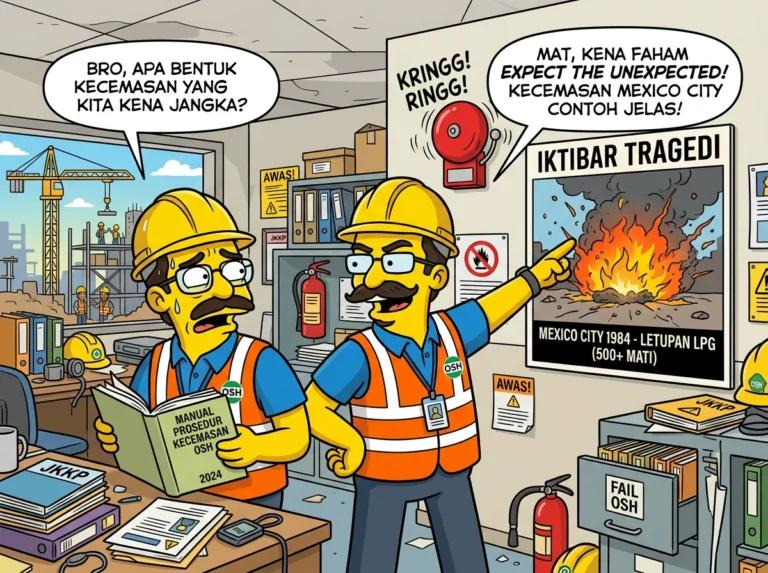
At approximately 5:35 PM on November 19, 1984, a massive and devastating explosion followed by a major fire occurred at the PEMEX LPG Terminal (government-owned) in San Juan, Mexico City.
Summary
The aftermath: 500 individuals were killed, and the plant was completely destroyed.
The terminal received its daily supply from three refineries. At the time, the plant was being filled because its stock was nearly depleted.
The facility contained two large spheres and 48 cylindrical vessels being filled to 90% capacity, along with four smaller spheres filled to 50% capacity.
A drop in pressure was detected in the control room and the pipeline pumping station. An 8-inch pipe between the spheres and the series of cylinders had ruptured.
Unfortunately, operators failed to identify the cause of the pressure drop. The release of LPG continued for 5 to 10 minutes until a gas cloud, measuring 200m x 150m x 2m high, escaped from the flare stack area.
The cloud ignited spontaneously, causing a massive ground tremor. Fire began to engulf the surface.
Plant workers attempted to flee; at one point, someone managed to press the “Emergency Shut Down” button.
Approximately 15 minutes after the first Boiling Liquid Expanding Vapor Explosion (BLEVE), a series of subsequent BLEVEs followed, and finally, the LPG vessels exploded violently.
The explosions caused a “rain” of scattered LPG, making the fire burn even more fiercely across the surface. The series of explosions was recorded on seismographs at the University of Mexico.
Causes
Another major obstacle for emergency teams during firefighting and rescue operations was the panic among nearby residents who scrambled to save themselves. Crowd control had failed completely.
The total destruction of the terminal resulted from overall safety weaknesses, primarily because the plant’s emergency isolation system failed to function effectively.
The firewater supply system was also damaged during the first explosion, and the water spray coverage was insufficient.
The installation of more effective gas detection and emergency isolation systems might have prevented the incident.
The plant was found to lack a gas leak detection system, and by the time the emergency isolation system was activated, it was likely too late.
Lesson Learned
The San Juanico incident demonstrates that large-scale LPG storage should never be located too close to densely populated residential areas. When a gas leak occurs, it can form a highly dangerous vapor cloud; if it encounters an ignition source, the result can be a massive explosion and fire. This is why facility site planning, safe separation distances, and development control around high-risk areas are critically important.
Furthermore, this incident teaches us that LPG facilities must be equipped with robust leak detection systems, emergency isolation, fire protection, and comprehensive emergency response plans. The layout of tanks and equipment must also be designed so that a single failure does not trigger a domino effect across the entire plant. In short, the key lesson from San Juanico is that major risks must be controlled from the outset through safe design, disciplined operations, and total emergency preparedness.