
Since 1977, Wisconsin Electric’s Fleet Services strengthened Public Employee OSH performance by treating safety as behaviour, not just paperwork.
Their approach blends Behaviour-Based Safety, self-observations, tight feedback loops, and leadership reinforcement to build real habits, not box-ticking.
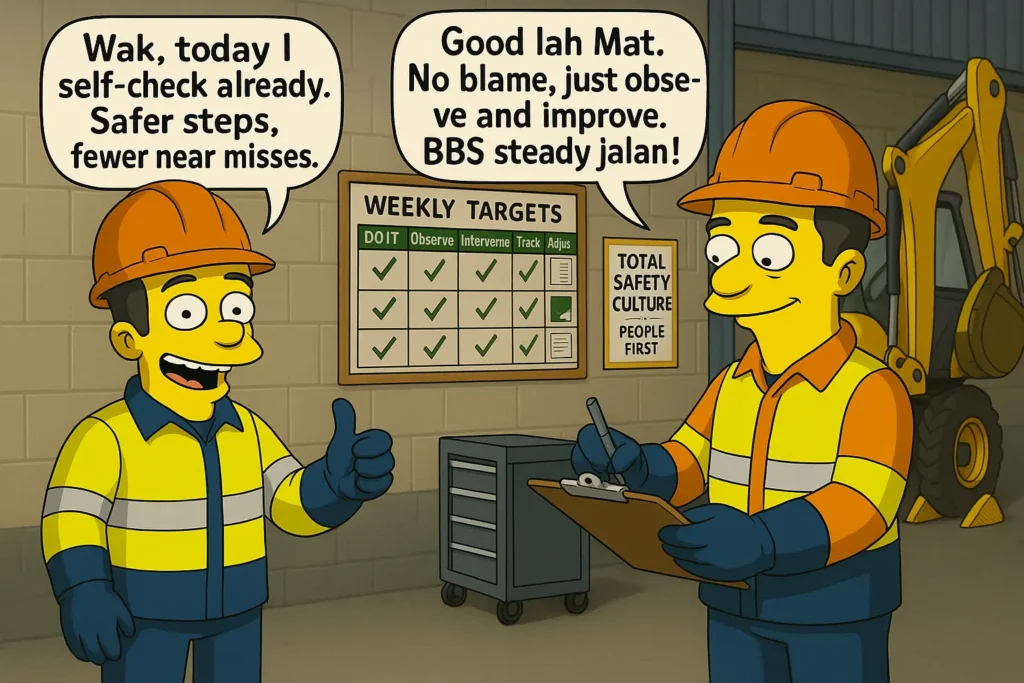
Why Fleet Services Chose BBS
The transport maintenance team handles vehicle and heavy equipment repair, including backhoes, and supports electrical and natural gas infrastructure projects.
They already had solid engineering and compliance practices, but their best safety records came after adopting Behaviour-Based Safety (BBS) and growing it into a Total Safety Culture.
The mission was simple and practical:
“Fleet Services practices one-team cooperation to achieve a Total Safety Culture and create a safe work environment.”
The main workshop is in Milwaukee, with remote satellite sites. Total headcount is 74, and about 70 are union members. With dispersed work and many solo assignments, they needed a system that keeps safety front-of-mind even when a supervisor is not around.
Safety Culture That Goes Beyond Engineering and Law
Great safety is not only about engineering, technical controls, or legal compliance. Incidents often start with human behaviour. To reach excellence, they addressed the human dimension directly.
Key ideas they worked on:
- Reduce at-risk behaviours, grow safe habits. When behaviors shift, the safety system becomes stronger and more resilient.
- Use psychology the right way. Make it easier for people to do the right thing, and harder to do the wrong thing.
- Give people tools, choice, and ownership. Individuals need the chance to act safely, feel personal control, and protect teammates.
- Reinforce with leadership. Formal OSH management systems plus everyday leadership behaviours create recognition, encouragement, and accountability.
Bottom Line
Total Safety Culture needs ongoing observation, feedback, evaluation, and adjustment. It thrives on open communication and frequent touch points, not one-off campaigns.
Observation, Feedback, and Confidential Data
They issued a short checklist to selected employees for observing interpersonal behaviours on the job. The checklist captured:
- Behaviour type and action taken
- Risk rating
- A Comments field for specific, practical notes
Names and responses were confidential. This encouraged honest input, quicker detection of at-risk patterns, and faster preventive action. Observation cards were collected, consolidated, and shared with crews as group feedback so everyone could learn without finger-pointing.
The “DO IT” Cycle with Six Practical Steps
Data from observations only matters if it drives action. They used a simple but disciplined loop, often called DO IT, adapted here into six plain steps:
- Define the targeted behaviour to increase or decrease.
- Observe the current baseline and set a clear, realistic performance measure.
- Intervene with a suitable action, cue, or support to influence the behaviour.
- Track Impact by continuing observations against the same measure.
- Adjust if targets are not met. Add or change interventions.
- Escalate or Sustain by flagging stubborn, critical behaviours for focused improvement, or locking in gains with recognition and standard work.
This loop kept improvements visible and practical. People could see what changed, why it changed, and what to do next.
Self-Observations is The Game Changer for Remote Work
Because many fleet staff work alone at remote bays or in the field, they added Self-Observation as a formal method.
The monthly ratio of self-observations to peer observations averaged 50 : 30. Quality was high because workers wrote meaningful comments and suggested improvements.
A typical self-observation process:
- Identify the targeted behaviour to improve.
- Set a measure for that behaviour.
- Choose self-management strategies, like checklists, reminders, or trigger cards.
- Record progress on simple charts.
- Keep measures specific, achievable, and trackable.
The company validated outcomes by checking for evidence of practice, cross-referencing injury data, reviewing near-misses, and comparing before vs after records. The idea is simple: if behaviour really changed, the risk profile and incident trend should also move in the right direction.
Social-cognitive theory says self-observation is central to self-regulation. When people watch their own behaviour, they tend to align actions with values and plans.
If what we do clashes with what we believe, we feel uncomfortable, so we correct course. In safety, that discomfort nudges us back to safe choices.
What Makes Their BBS Stick
- Clarity and confidentiality. Clear behaviours to observe, confidential input, non-punitive tone.
- Short feedback loops. Data shared quickly with crews, so insights become actions.
- Leadership praise, not just policing. Reinforce what goes right to make it repeatable.
- Integration, not add-on. BBS is part of the OSH system, not a side project.
- Fit for solo work. Self-observations keep standards high when no one is watching.
Lessons for Any Malaysian Workplace
- Forms do not keep people safe. People keep people safe. Checklists are tools. Commitment turns them into results.
- Target behaviours, not slogans. Define what “safe” looks like in observable actions.
- Make feedback normal. Frequent, respectful feedback beats annual campaigns.
- Protect honesty. Confidential reporting builds trust and better data.
- Design for reality. If staff often work alone, build self-observation into the system.
- Close the loop. Share data, act on it, track impact, adjust, repeat.
Lesson Learned
A strong safety system is not a stack of files. It is a living routine of clear behaviours, honest observations, fast feedback, and steady leadership. When people own their choices and managers reinforce the right habits, safety becomes the way work is done, not an extra step.