
A fire at a tower project exposed how unpreparedness and poor communication can turn a simple drill into chaos. Here’s what went wrong, and what every company can learn from it.
Fire incidents may be unpredictable, but most of them are caused by human negligence or a lack of awareness about fire hazards. Every year, we read news about fires, at homes, factories, offices, and even schools.
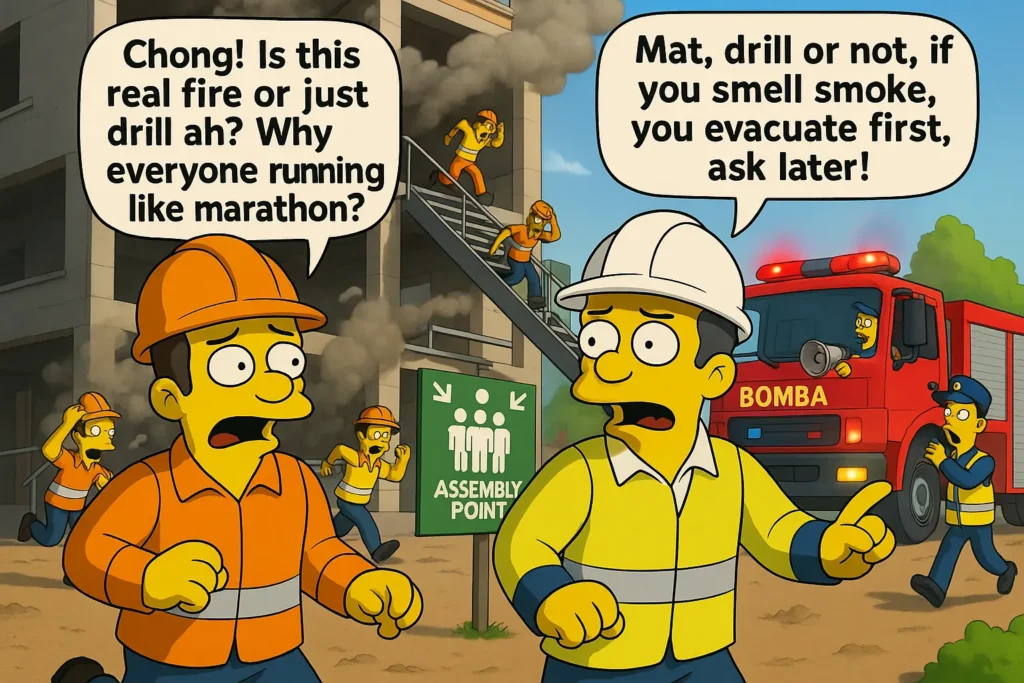
Recently, a “fire” was reported at the Menara K construction project. The emergency bell rang, and workers began evacuating to the designated assembly point.
Outside the site, people stopped to watch and take pictures as ambulances and fire trucks rushed in with sirens blaring. Traffic slowed down as curious onlookers gathered along the roadside.
Inside, some workers were still taking their time despite being told to evacuate quickly. The Safety, Health and Environment (SHE) Officer shouted through the loudspeaker, “Move faster, move faster!” Yet, some workers calmly took the lift instead of the stairs.
Once the “drill” timer ended, the SHE Officer, Risk Assessment Officer, Senior Engineer, and the Fire and Rescue Department (BOMBA) went back inside to confirm that no one was left behind. After an hour of checking, recording statements, and clearing the area, the building was declared safe, and work resumed.
The incident turned out to be a fire drill simulation, but the results were alarming.
Fire Drill Results – A Failed Test
According to the assessment, seven “deaths” were recorded: two supervisors, two tower crane operators, and the rest were general workers.
Out of twenty “injured,” three were from the SHE support team, including an office administrator and a store clerk. Luckily, no public injuries were reported.
Roughly 70% of site assets were “saved,” mostly machinery and equipment stored outside. Items lost in the “fire” included furniture and computers. The tower structure itself remained stable, with only minor window damage.
BOMBA managed to “extinguish” the fire within 15 minutes. The cause of the simulated fire was traced to uncontrolled welding sparks.
Final result: FAILED.
A repeat fire drill would be required.
Why the Fire Drill Failed
(a) System Weakness
Investigations found that documents like the Quality, Safety, Health and Environment (QSHE) Plan were available at the site office. However, the section on “Fire Prevention” only mentioned drills in general. There were no clear instructions on emergency actions or evacuation procedures.
The fire drill notice was only emailed, not printed or displayed. Worse, the notice was issued just one week before the drill, which left many workers unaware. The justification was that management wanted to “test natural reactions.”
In reality, fire drills must be planned and communicated properly, ideally at least a month in advance. Notices should be posted on bulletin boards, shared through memos, email, or even company websites to ensure everyone is informed.
(b) Response During the Emergency
Findings revealed that most of the “casualties” were supervisory staff and SHE personnel themselves. Their lack of urgency led many workers to take the drill lightly.
Some supervisors admitted, “It’s just a drill, not a real fire.” That attitude caused slow evacuation and confusion.
The tower crane operator was also unaware of the drill. No one informed him via walkie-talkie or phone, and by the time he realised what was happening, it was too late, he too was listed among the “fatalities.”
Still, BOMBA highlighted two positive aspects:
- The fire hydrant system functioned well, even though the project was still under construction.
- The fire extinguishers were used correctly by SHE staff and a few workers before BOMBA arrived.
Lesson Learned
Fire incidents are unpredictable and often tragic, but most can be prevented through planning and awareness. Every organisation should treat fire drills seriously, not as a formality.
A good drill is not about “catching people off guard.” It’s about building a culture of readiness, where everyone knows what to do and acts fast when it truly matters.
Early preparation, communication, and education remain the best defences against fire hazards.