
Many safety, health, and environmental officers still confuse audits with inspections. Some even perform inspections during audits, which leads to wasted time, inaccurate findings, and reports filled with unnecessary non-conformances that focus too much on product or material issues instead of system gaps.
Workplace Inspection
An inspection in occupational safety, health, and environment (HSE) is a routine activity, not necessarily scheduled, and can be done anytime, even as a surprise visit.
Inspections are closely related to daily operations and ongoing work. Their main purpose is to check compliance with standards, contracts, specifications, construction practices, production processes, and machinery. The goal is to ensure that both products and services meet legal and safety requirements.
If hazards or unsafe conditions are found, a non-conformance or observation report can be raised immediately. Typical participants include clients inspecting contractors or suppliers, and contractors inspecting their sub-contractors or vendors.
A checklist should always be prepared before conducting an inspection. Each checklist must be specific to the product or service. For example, an inspection on a piping system should use a checklist designed for piping. Safety, health, and environmental elements must also be included.
To maintain consistency, every company should establish standard operating procedures (SOPs) or method statements (for construction) that define how inspections are conducted under controlled conditions.
Inspections can be carried out by qualified supervisors, assisted or coordinated by safety and health officers. Both experienced auditors and inspectors view findings as opportunities to improve the management system, product quality, and services.
Workplace Audit
An audit, on the other hand, is not routine. It must be scheduled, typically conducted after a certain operational period, for example, every six months. Audits must be announced with enough notice for the auditee to prepare.
Common audit types include:
- First-party audit: Conducted by the client or its representative on contractors or suppliers (external audit).
- Second-party audit: Conducted internally by the company on its departments, sub-contractors, or suppliers (internal audit).
- Third-party audit: Conducted by an independent body, such as a certification agency or government authority.
An audit focuses on systems and management processes, not the physical site alone. The aim is to evaluate compliance with procedures, policies, and standards such as ISO 45001 and ISO 14001.
Auditors should be independent of the area being audited to avoid bias. Non-conformances can be raised if gaps exist in documentation, implementation, or record-keeping. For example:
- Required documents or records are missing.
- Procedures exist but are not followed.
- The documentation is incomplete or needs revision.
Typical steps in an audit include forming the audit team, conducting briefings, defining the audit scope and location, preparing checklists, sending audit notifications, holding opening and closing meetings, issuing reports, conducting follow-up audits, and verifying corrective actions.
Audit results are often categorized into major non-conformances (NCRs), minor NCRs, and observations. Continuous improvement should follow every audit cycle.
During the audit, professionalism and ethics are crucial:
- Do not disrupt normal site operations.
- Stay diplomatic and avoid being overly harsh.
- Focus on significant issues, not minor details.
- Avoid hearsay and always verify facts.
- Communicate in simple, clear language.
- Explain findings when asked.
- Avoid unnecessary arguments with the auditee.
Lesson Learned
Understanding the difference between inspection and audit is fundamental for any OSH or environmental professional. An inspection looks at immediate compliance and physical conditions, while an audit examines systems, procedures, and management practices that sustain long-term safety performance.
When both are done properly, they complement each other, inspection keeps daily operations safe, while audit ensures the entire safety management system works as intended.
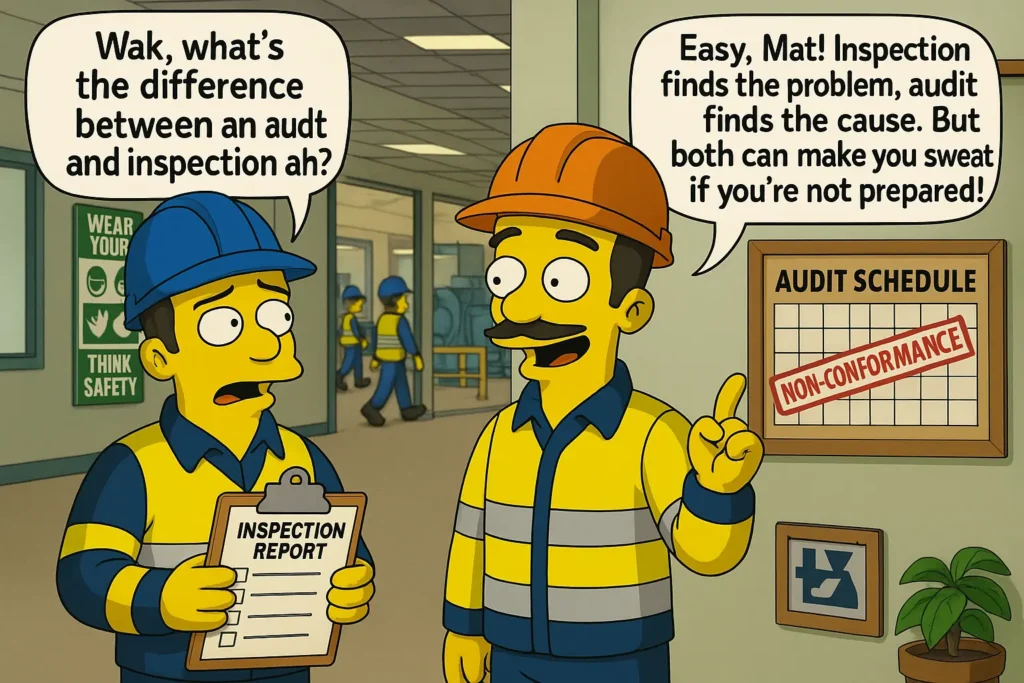
In short: inspection finds the problem, audit finds the cause. The best organisations use both effectively to prevent accidents, ensure compliance, and continuously improve workplace safety culture.