
A Safety and Health Policy, or as some people now call it, the OSH Policy, is basically a written statement that shows the management’s commitment towards the safety and health of their workers.
Under Section 16 of the Occupational Safety and Health Act 1994 (OSHA 1994), it is mandatory for any organisation with more than five employees to have one.
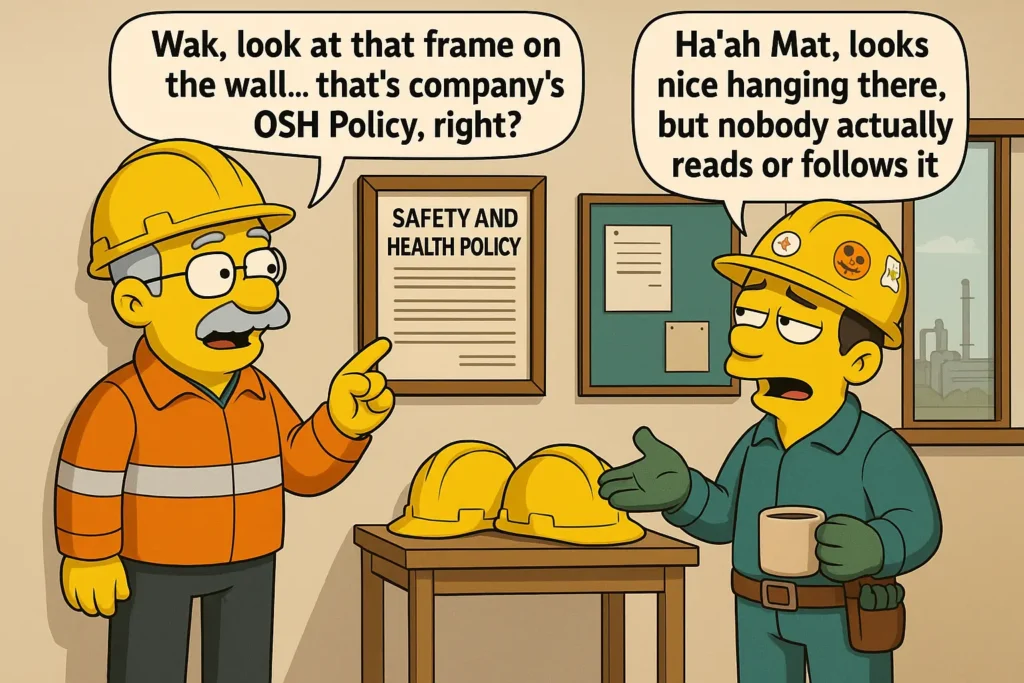
In simple words, this OSH Policy is like a formal promise from the employer. It is similar to how someone takes an oath during marriage, when accepting an official position, or when pledging something important.
But in Malaysia, with so many kinds of “promises” being made everywhere, it is not surprising that this one is often taken lightly too. Some even joke,
“I made a promise before marriage ten years ago and still have not fulfilled it, what more those election manifestos?”
Okay, maybe let’s not go political here.
Still, this is the kind of talk we often hear from the industry.
“Small companies, like our factory, do not need a Safety Policy. We are located in a remote area, far from the public. There has never been any serious accident or property damage anyway.”
“And if any accident does happen, we just report it as an “outside” accident, maybe while coming to work. PERKESO can handle that, so why waste money buying extra insurance? After all, it was the Bangladeshi worker who lost his finger, not one of our own. Just pay the clinic for treatment, give him some compensation, and buy him a one-way ticket back to Bangladesh.”
When reading through all these comments, more than 10 offences committed without realising it. This kind of mindset will only lead to trouble.
“We can just hire a fresh graduate to be our Safety and Health Officer (SHO) and be done with it. There are plenty of graduates without jobs anyway. No need for training because they already have degrees. What we really need are “tontos” or agents to monitor if DOSH is coming for inspection.”
“Our supervisors only need to check technical matters, not safety issues. The SHO does not need to understand technical problems because they are not engineers. If DOSH visits or an accident happens, just call the SHO. Management does not have to get involved.”
“Also, PPEs are expensive. Helmets, harnesses and other safety gear cost a lot. Why spend so much?”
Lesson Learned
An OSH Policy is not meant to be just a framed document in the lobby to impress visitors. It represents the organisation’s true commitment to protecting the people who work within its operations.
To make it meaningful, the policy must be communicated clearly to everyone who may be affected by the company’s activities, including employees, contractors, and visitors.
Each objective stated in the policy should be translated into real actions, monitored consistently, and reviewed from time to time to ensure that it remains relevant to the nature and size of the organisation.
Top management plays a key role in setting the tone. They should actively emphasise the importance of the policy during meetings, briefings, or townhall sessions, showing that safety is not just the responsibility of the SHO but a shared value across all levels.
Leadership by example builds trust and accountability among workers.
Ultimately, a Safety and Health Policy only has value when it is lived out daily — when people understand it, believe in it, and act according to it. A clear, practiced, and well-supported policy reflects a company that truly values the wellbeing of its workforce.