
A renovation project in northern Malaysia turned into a full-blown legal disaster after multiple OSH mistakes and violations, from unregistered workers to expired insurance. Here’s what went wrong and what every contractor should learn.
The Case That Shocked Investigators
An entrepreneur bought an old five-storey shop-lot building in a quiet northern town. The building had been abandoned for more than three years.
A contractor was hired to repair, strengthen, and partially demolish the structure before rebuilding it. But not long after work began, a family reported that one of their relatives suffered severe leg fractures after falling from height at the site.
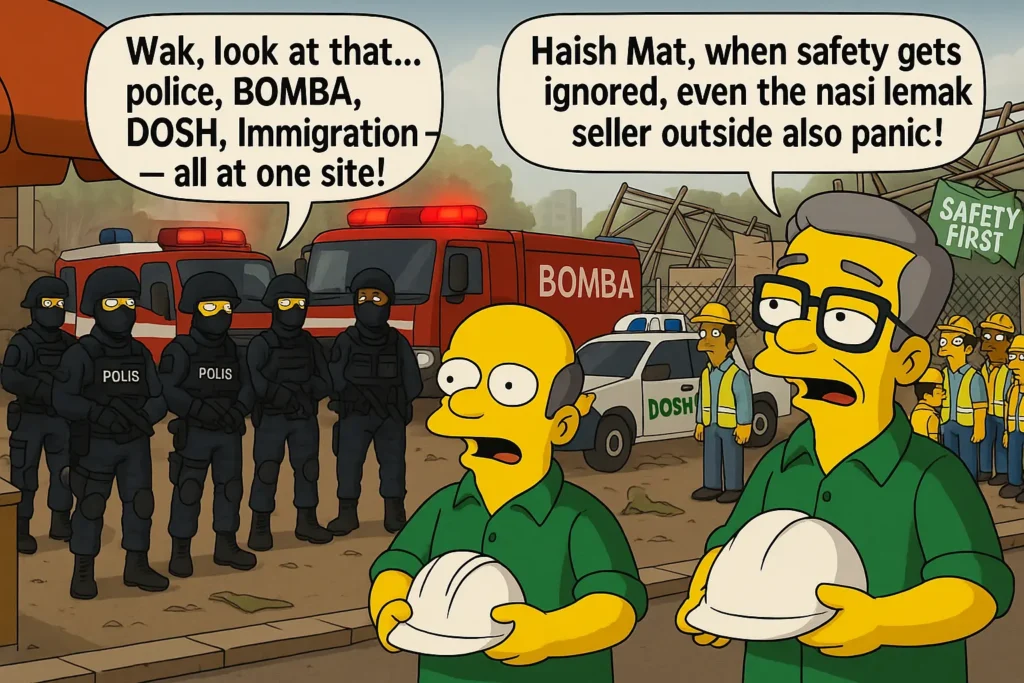
When authorities, including DOSH, the local council, and Immigration officers, raided the project with two engineering and risk management consultants, they uncovered a long list of violations. Even worse, the employer allegedly falsified the cause of injury when sending the victim to the hospital.
So, what exactly went wrong? Let’s break it down.
1. No Proper Risk Identification or Control
The contractor failed to assess, prevent, and manage risks even though the project carried high hazards. No risk assessment appeared in the project schedule or work programme.
2. Unapproved Drawings and Plans
While the land survey was done by a certified surveyor, none of the drawings were signed or endorsed by the local authority or a professional engineer.
3. Unlicensed Demolition Work
Structural removal was carried out by unregistered subcontractors with no valid licence or competency.
4. Weak Site Barricades
Site hoardings were made from plywood with no proper warning signage, except a small notice pasted on the guard post.
5. No DOSH Registration
The project was not registered with DOSH or the local authority. The contractor was only registered under CIDB as a G5 firm with three green card holders under the “Management” category only.
6. Incompetent Site Supervisor
Only one supervisor was appointed as the site safety officer. He had never attended any NIOSH course, was not registered with the Board of Engineers Malaysia (BEM), and lacked any professional safety qualification.
7. No Safety and Health Committee
Despite having around 70 workers, there was no formal safety and health committee as required under the OSH Regulations.
8. Expired Insurance and No PERKESO Coverage
Not all workers were insured or covered under PERKESO. The project insurance had already expired, leaving only executive staff and machinery insured.
9. Irrelevant Safety Checklists
The checklist used was a civil engineering list that ignored all Occupational Safety, Health and Environmental (KKPA) elements.
10. Defective Safety Nets and Platforms
Safety nets and catch platforms were installed only on the first floor, and even those were torn or damaged.
11. Poor Worker Accommodation
The workers’ quarters had no approved layout. Most workers were undocumented migrants living in poor, unhygienic conditions. Food was uncovered, flies were everywhere, and toilets were crude wooden structures with water stored in buckets from public taps. Evidence of open burning was also found nearby.
12. Unsafe Site Access
Children from a nearby village were seen playing inside the construction area during inspection, a clear failure in site security and public safety.
13. PPE Misuse
Some workers wore safety helmets and belts, but many used the wrong PPE or none at all. Several were found wearing slippers while working at height.
14. Unsafe Scaffolding
Three scaffold structures showed severe defects, missing bracings, toe boards, and catwalks. Many nuts were missing, and records revealed the same scaffolds had been reused on at least five other projects without replacement.
15. Incomplete Project File
The Project Manager’s site diary was incomplete. Toolbox meetings were held, but the minutes did not mention any OSH topics or show evidence of worker induction training.
16. Unreported Previous Accidents
Minor injuries from earlier works were not properly recorded or reported to authorities as required under OSHA 1994.
17. Poor Material Storage
Building materials like cement, bricks, and steel were left exposed in a leaking store. Bags of cement were scattered, some hardened, and workers used hammers to break the clumps.
18. Unsafe Chemical Handling
Open paint cans and thinner containers were left uncovered and unlabelled, violating basic chemical safety requirements.
19. Intimidation and Corruption Attempt
The project owner arrived with two thugs to threaten and bribe the enforcement team. Immigration called the police, and the owner, along with the thugs, was arrested on the spot.
20. Expired Machinery Certificate
A backhoe crane was found operating with an certificate of fitness (CF).
Immediate Action Taken
The entire project was shut down immediately for breaching multiple laws. Several undocumented workers were detained by Immigration, and the project owner, main contractor, and subcontractors now face serious legal action including heavy fines and possible imprisonment.
Lesson Learned
Many contractors know how to build structures but fail to build safety systems. Worker welfare, health, and environmental management often take a back seat to profit.
Neglecting safety is not just a legal risk, it’s a moral failure that endangers lives and reputations. Responsible project management means balancing progress with protection, profit with people.